
HighLevel Independent Software Decision Guide: Fit, Plans, True Cost, Replacement, Migration, Agency Economics, Risks and Exit
HighLevel at a Glance
What is HighLevel?
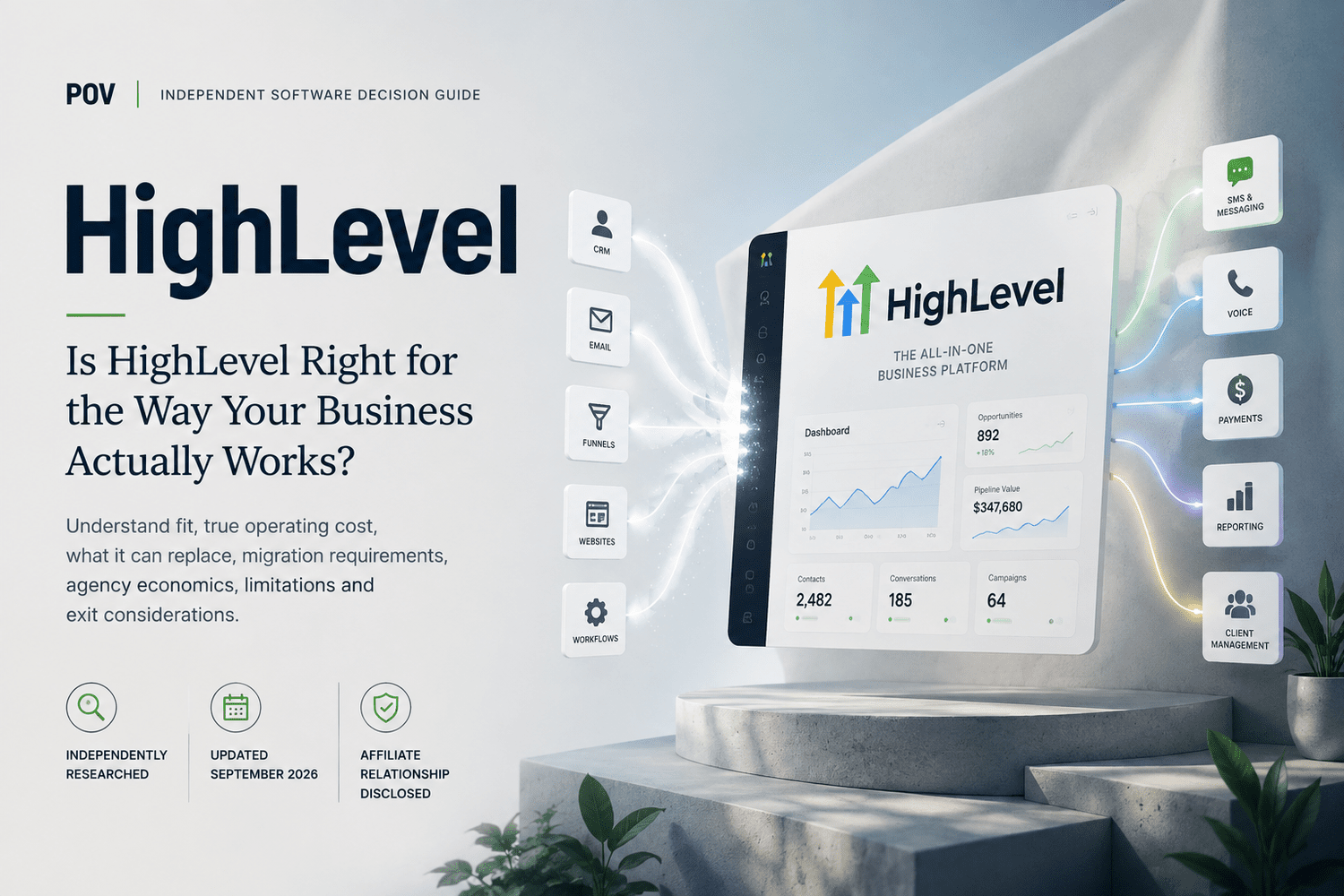
HighLevel is an all-in-one software platform combining CRM, marketing automation, customer communication, websites and funnels, calendars, reputation management, payments, and agency-oriented capabilities.
It is particularly relevant to marketers, agencies and businesses that would otherwise assemble several separate systems to manage customer acquisition, follow-up and client operations.
Those subscription prices are important. They are not necessarily the total HighLevel operating cost. Phone, messaging, email, AI, A2P requirements, premium workflow actions and optional products can introduce additional charges depending on usage.
Your Decision Starting State
The right HighLevel decision depends on what you are starting with.
Two businesses can evaluate the same HighLevel features and reach different decisions because their operating models, existing systems, implementation burden and failure consequences are different.
Establish the conditions that can change the decision.
Are you starting from scratch, solving a specific operating problem, or replacing an existing software stack?
Are you operating one business, managing multiple client businesses, or reselling software as part of your service model?
How many accounts, locations, users, client environments, workflows and communication channels must the platform support?
What happens if customer data, communications, automations, scheduling or client operations fail during the transition?
Can your organization realistically configure, migrate, validate and maintain the system it intends to adopt?
Which external systems, integrations or operating processes may still be required after HighLevel is implemented?
What information, workflows, communication assets, phone resources, permissions and historical records must survive?
Are there industry, communication, privacy, compliance or client requirements that materially affect configuration or suitability?
Is HighLevel Actually Right for You?
Start With Your Operating Model
A local business operating its own CRM has a different HighLevel decision from a marketing agency managing multiple client accounts. An agency managing client accounts has a different decision from an agency packaging HighLevel as a recurring SaaS product.
HighLevel May Be a Strong Fit When
You need meaningful consolidation across CRM, automation, communication, funnels or client management; manage multiple client environments; repeatedly deploy similar systems; or want agency functionality built around a common platform.
HighLevel May Deserve More Caution When
You need only one narrow function, a mission-critical existing system has only partial replacement coverage, your team cannot realistically implement the transition, or important integration, ownership, security, compliance or data-control questions remain unresolved.
Which HighLevel Plan Do You Actually Need?
| Decision Variable | Starter | Unlimited | Agency Pro |
|---|---|---|---|
| Monthly subscription | $97 | $297 | $497 |
| Users | Unlimited | Unlimited | Unlimited |
| Sub-accounts | Up to 3 | Advertised as unlimited | Advertised as unlimited |
| Primary operating model | Limited account footprint | Multi-client agency | SaaS / advanced agency |
| SaaS Mode | No | No | Yes |
Starter — $97/month
Starter can make sense when a business primarily operates HighLevel internally or remains within a small account footprint. HighLevel currently advertises up to three sub-accounts on Starter.
Unlimited — $297/month
Unlimited becomes materially more relevant when a business manages multiple client accounts. HighLevel advertises unlimited sub-accounts on this tier.
Agency Pro — $497/month
Agency Pro becomes particularly relevant when HighLevel becomes part of what the agency sells, rather than only a tool the agency uses. SaaS Mode and broader agency monetization capabilities make the economic comparison different from a normal software upgrade.
The relevant break-even question is whether Pro-only economic contribution creates at least roughly $200 per month more value than Unlimited after applicable additional costs.
The Plan Promotion Gate
Do not move up a HighLevel plan simply because the next tier contains more capabilities. Promote only when the buyer's operating model creates a requirement that the lower tier cannot adequately satisfy.
Begin with the lowest tier that supports the buyer's actual account footprint and required operating behavior.
Separate incremental capability from features already available on the current candidate plan.
A useful capability that is not part of the buyer's intended operating model is not yet a reason to upgrade.
For Unlimited versus Agency Pro, the current subscription difference is approximately $200 per month before other operating costs.
What Will HighLevel Really Cost?
Separate the Four Economic Questions
A software decision can produce several different cost states. Keeping them separate prevents subscription pricing, migration cost, steady-state savings and agency economics from being collapsed into one number.
Know which cost question you are answering.
What does HighLevel cost under the way you intend to use it?
What does the technology environment cost while HighLevel and legacy systems operate together during migration and validation?
What does the technology stack cost after validated legacy dependencies have actually been removed?
For agencies, what remains after client reimbursement, markup, SaaS revenue, support burden, labor and other applicable operating expenses are considered?
Phone, SMS & Voice
Current LC Phone documentation lists usage charges in addition to number rental. Published examples include approximately $0.0079 per SMS segment, approximately $0.0180 per outbound voice minute, and approximately $0.0085 per inbound voice minute.
A2P Messaging
Businesses using U.S. local business numbers for SMS or MMS can be subject to A2P 10DLC requirements and related registration, campaign, carrier and messaging charges.
Current HighLevel documentation lists email sending around $0.675 per 1,000 emails and email verification around $2.50 per 1,000 verifications.
AI Employee
HighLevel currently offers pay-per-use AI as well as AI Employee subscription options. Current first-party documentation includes AI Employee Growth at $50 per month per enabled location and AI Employee Unlimited at $97 per month per enabled location.
Premium Workflow Executions
Some workflow actions are treated as premium executions. A business relying heavily on premium triggers, actions or Marketplace apps can therefore have a different automation cost profile from one using mostly standard actions.
ASK: “WHAT WILL HIGHLEVEL COST UNDER THE WAY I INTEND TO USE IT?”
What Can HighLevel Actually Replace?
Functional Coverage
HighLevel provides capabilities across CRM, sales pipelines, email, SMS, scheduling, funnels, websites, forms, automation, reputation, payments, courses, memberships, call tracking, social publishing, client management and AI-assisted workflows.
Retained Dependencies Matter
The useful economic question is not how many products HighLevel resembles. It is how many existing products can actually be removed from the steady-state technology stack after validation.
Give Every Existing Dependency a State
An existing system should not disappear from the decision model simply because HighLevel has overlapping functionality. Assign each dependency a real operating state before calculating replacement or savings.
| Dependency State | What It Means | Economic Effect | Decommission Implication |
|---|---|---|---|
| Replaced | HighLevel has passed the required replacement validation and the external system is no longer operationally required. | Legacy cost may become removable. | Candidate for decommission after acceptance criteria pass. |
| Retained | The external system remains necessary in the intended steady-state stack. | Its cost remains part of steady-state economics. | Do not treat it as eliminated. |
| Migrated | Required data, configuration or business behavior has moved to HighLevel. | May enable future cost removal. | Migration alone does not establish safe cancellation. |
| Reconnected | The external system remains active and is integrated with the new HighLevel environment. | External cost and dependency remain. | It is part of the operating architecture, not a replacement. |
| Temporarily Duplicated | Old and new systems remain active during migration, validation or parallel operation. | Creates transition-period duplicate cost. | Wait for validation and decommission readiness. |
| Unresolved | Evidence is not yet sufficient to determine the final state. | Savings cannot yet be claimed. | Creates a validation or research requirement. |
What Does It Actually Take to Move to HighLevel?
Inventory Before Migration
Before moving systems, inventory the business functions, data, automations, integrations, users, permissions, communication infrastructure, custom fields, historical records, reporting, payments, domains, phone resources and administrative control in the existing stack.
HubSpot → HighLevel Migration
HighLevel currently provides a dedicated HubSpot importer supporting data classes including contacts, deals mapped to opportunities, companies, fields, pipelines, stages, emails, notes and tasks.
Current documentation also identifies limitations involving certain associations, calculated fields, recurring tasks, imported email behavior and reimport conditions.
Parallel-Run Economics
Realized Consolidation Economics
The Decommission Gate
Migration tells you whether something has moved. Decommission readiness tells you whether the old dependency is safe to remove. Those are different decisions.
Required data, configuration, workflows or assets have reached their intended destination.
Production-like tests demonstrate that required business behavior works adequately in the new environment.
External systems, integrations, permissions and operational relationships required after migration are known.
Critical workflows, communications, reporting and client operations continue at an acceptable level.
Required business-critical assets and processes have an acceptable recovery or reconstruction path.
Only after the preceding requirements pass should a legacy platform become a candidate for cancellation.
How Does HighLevel Work Economically for an Agency?
Sub-Account Architecture
HighLevel advertises unlimited sub-accounts on Unlimited and Agency Pro. This allows agencies to maintain separate client environments within a broader agency account structure.
Snapshot Governance
Snapshots can copy supported configuration and assets across client environments. They should not be interpreted as a universal continuous synchronization system.
Rebilling
HighLevel supports rebilling for certain products and usage categories, but individual products can have different rules.
REBILLING → WHO ULTIMATELY PAYS IT?
MARKUP → DOES THE AGENCY GENERATE GROSS REVENUE?
Agency Net Economics
This is a Page One Visibility decision model, not an official HighLevel accounting formula. Real profitability also depends on support, labor, payment processing, churn, taxes and other operating expenses.
What Should You Know Before Depending on HighLevel?
Negative Fit Is Continuous
Negative-fit analysis should not appear only at the end of a software guide. Every material decision stage should test whether a constraint disqualifies the current path or creates a question that still requires verification.
Ownership & Control
For each business-critical asset, understand who owns it, who controls it, who can export it, who can transfer it, who can delete it and who can recover it.
Export Is Not the Same as Reversibility
An export can preserve some records without preserving the complete operating environment that produced them. Reversibility therefore requires a broader test than whether a download button exists.
Evaluate the asset across its full operating lifecycle.
Can required records or files be extracted from the platform?
Can control or possession move to another account, client, provider or operating environment?
Does the exported information preserve enough structure to recreate required workflows, history, permissions and business behavior elsewhere?
After failure, cancellation or transfer, can the business restore the critical function rather than merely possess a copy of some underlying data?
Integration Risk
Integration is not migration. When HighLevel still depends on an external platform, middleware provider or custom connection, that dependency remains part of the operating architecture.
Human Adoption
Cancellation, Transfer & Reversibility
Current HighLevel documentation describes limited retention windows after cancellation, account-pause functionality, and mechanisms for transferring or ejecting sub-accounts. These lifecycle details matter because cancellation is an operational event, not merely a billing event.
Buyer Decision Standard
Do not decide from feature count alone.
Resolve your business reality, required functions, product overlap, retained dependencies, required plan, true operating cost, migration requirements, validation, decommission readiness, ownership, recovery and exit before treating the decision as complete.
Decision Summary
Is HighLevel the right operating system for the way your business needs to work?
HighLevel makes its strongest case when you need several major capabilities to operate together, can successfully implement the system, and can validate enough replacement coverage to remove unnecessary legacy software.
It deserves more caution when critical requirements remain unverified, migration has not been inventoried, expected usage costs are unclear, ownership or recovery boundaries are unresolved, or the organization lacks the implementation capacity to use the platform effectively.
The useful question is therefore not simply whether HighLevel is a good product.
It is whether HighLevel is the right system for your operating model.
Unknown / Verify
A final HighLevel decision still depends on facts about your business.
A software guide can establish product truth and decision logic. It cannot legitimately manufacture buyer-specific operating facts that have not yet been measured.
These unknowns do not automatically make HighLevel a poor choice. They identify the evidence that still has the power to change the recommendation, plan, expected savings, migration risk or exit requirements.
| Material Unknown | Why It Matters | Could Change | How to Resolve It |
|---|---|---|---|
| Current software stack | Determines real migration paths, functional equivalence and which systems may remain. | Replacement / Migration / Cost | Current-stack inventory |
| Current software cost | Required to calculate real consolidation savings. | True Cost / ROI | Monthly and annual vendor-spend inventory |
| Communication usage | Email, SMS, voice, numbers and A2P can materially change operating cost. | True Cost | Measure historical and trial-period usage |
| AI usage | AI configuration and consumption can add incremental cost. | True Cost / Plan | Define actual AI use cases and measure trial usage |
| Migration inventory | Migration support and labor depend on the source platform, data class, workflow and integration. | Migration / Replacement | Asset, workflow and integration inventory |
| Retained dependencies | External systems that remain after migration continue to create cost and operational dependency. | Replacement / Steady-State Cost | Dependency-state audit after representative migration |
| Implementation capability | A technically capable platform can still fail operationally if the organization cannot deploy and maintain it. | Fit / Risk | Production-like trial with actual users |
| SaaS / resale intent | Could materially strengthen the case for Agency Pro. | Plan / Agency Economics | Business-model decision and Pro economic test |
| Client support burden | Client-facing SaaS or platform delivery can create new support and labor obligations. | Agency Economics | Model provisioning, support and ongoing service workload |
| Asset recovery capability | Export availability does not prove operational reversibility. | Ownership / Exit / Risk | Controlled recovery or reconstruction test |
Test the Decision
Use a trial to remove the highest-risk unknowns.
A useful trial is not a general tour of HighLevel features. It is a controlled environment for testing the business-specific conditions capable of changing your decision.
| Validation Test | What It Resolves | Acceptance Criterion | If It Fails |
|---|---|---|---|
| Real Workflow Test | Whether HighLevel reproduces a business-critical workflow rather than merely containing similar features. | Required triggers, conditions, timing, outputs and downstream actions perform adequately. | Retain the current dependency or redesign the implementation before replacement. |
| Representative Data Import | Whether required records and relationships survive migration. | Required contacts, fields, opportunities, histories and relevant records arrive with acceptable integrity. | Do not broaden migration or decommission the source system. |
| Required Integration Test | Whether external dependencies continue to function. | Authentication, data exchange and required business behavior remain reliable. | Retain or redesign the dependency architecture. |
| Communication Sequence | Email, SMS, routing, registration, deliverability and usage behavior. | Communications operate adequately under representative production conditions and measured cost. | Resolve communication architecture before production migration. |
| Permission / Client Isolation Test | Whether client users receive appropriate access and separation. | Required users can access what they need without inappropriate cross-client visibility or control. | Correct the account and permission architecture. |
| Replacement Test | Whether a legacy function can actually leave the steady-state technology stack. | HighLevel reproduces the required business behavior without an unacceptable retained dependency. | Keep the legacy system in the steady-state stack. |
| Transition-Cost Test | What adoption costs while old and new environments coexist. | HighLevel + legacy software + implementation + temporary duplication fit within an acceptable transition budget. | Re-sequence, reduce scope or reconsider timing. |
| Steady-State Cost Test | Whether expected consolidation savings actually survive after retained dependencies are known. | Verified legacy removals produce an acceptable final operating cost. | Recalculate the consolidation case. |
| Pro Economic Gate | Whether Agency Pro creates enough incremental value over Unlimited. | A required Pro-only capability produces measurable value that justifies the approximately $200 monthly subscription difference plus operating burden. | Remain on Unlimited. |
| Recovery Test | Whether business-critical information and operations are recoverable after failure, transfer or cancellation. | Required assets and operating functions can be reconstructed to an acceptable level. | Treat recovery as a material exit or continuity risk. |
| Human-Adoption Test | Whether real users can operate the replacement workflows. | Staff can complete required tasks reliably without unacceptable support burden. | Adjust implementation, training or fit assessment. |
| Decommission Acceptance Test | Whether the old system is genuinely safe to cancel. | Migration, functional validation, dependency resolution, continuity and recovery requirements have all passed. | Continue parallel operation and retain the legacy system. |
Ready to test HighLevel?
Use the trial to validate your actual operating model before replacing business-critical systems.
Test HighLevel for Your Business →Page One Visibility may receive compensation if you purchase or sign up through certain links on this page. Compensation does not determine the facts, limitations, decision standards or recommendations used in this guide.
Methodology
How Page One Visibility evaluates software decisions.
This guide begins with externally verifiable Product Truth and then reconstructs the decision a real business must make around that product.
Verified facts, conditional facts, conflicting evidence, unknowns, analytical models and recommendations are treated as different knowledge states.
The objective is maximum decision information gain, minimum unnecessary decision friction, and zero suppression of material decision risk.