

Commercial Window Tinting in Austin, Texas
Let me guess. Your AC runs all day. Blinds won't fix it. Shades won't either. Window tint will.
iTint ATX provides professional commercial window tinting for Austin-area businesses.
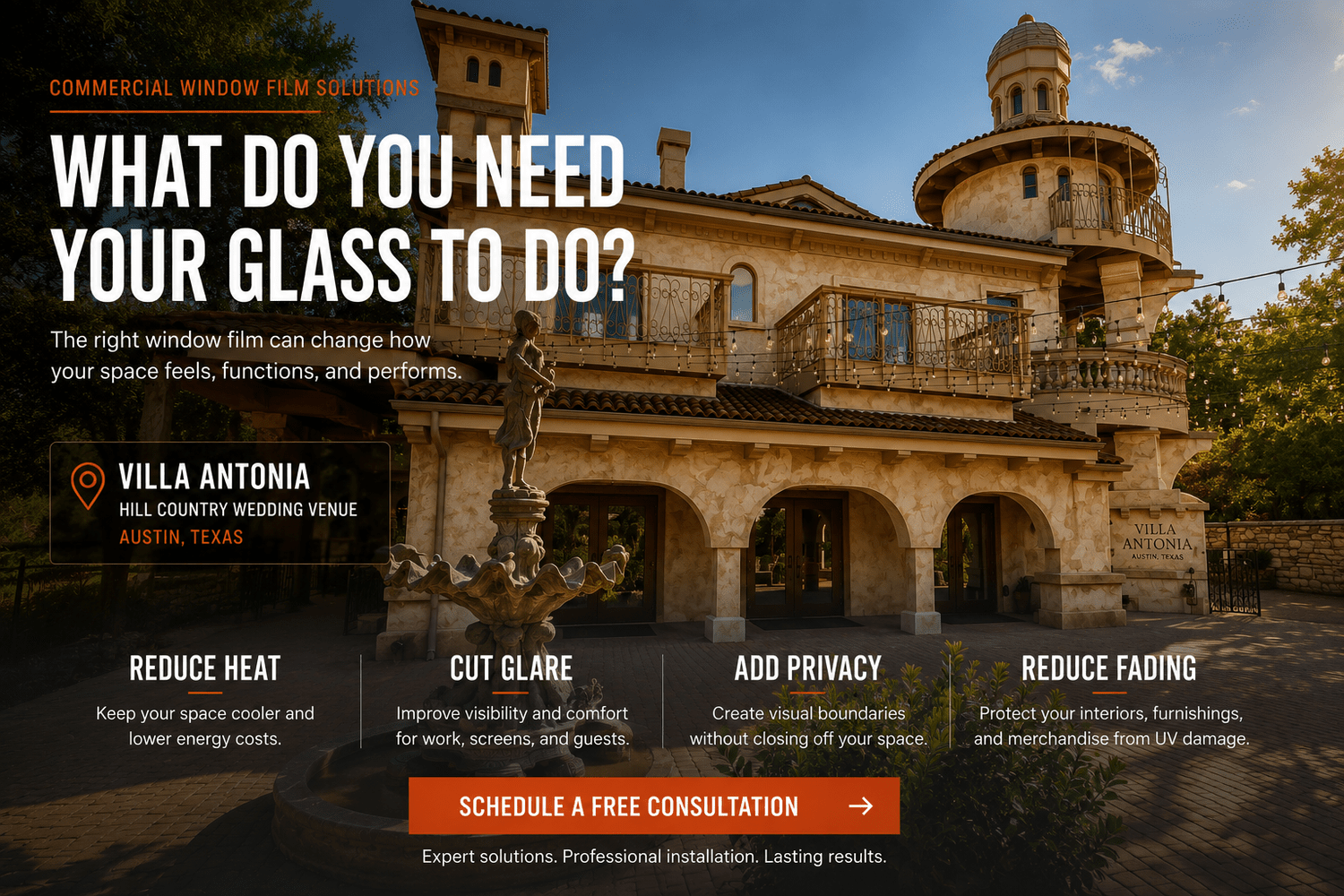
Commercial Window Film Solutions
What do you need your glass to do? The right window film can change how your space feels, functions, and performs.
Reduce Heat
Keep your space cooler and lower energy costs.
Cut Glare
Improve visibility and comfort for work, screens, and guests.
Add Privacy
Create visual boundaries without closing off your space.
Reduce Fading
Protect your interiors, furnishings, and merchandise from UV damage.
Villa Antonia is a Hill Country wedding venue in Austin, Texas.
Expert solutions. Professional installation. Lasting results.
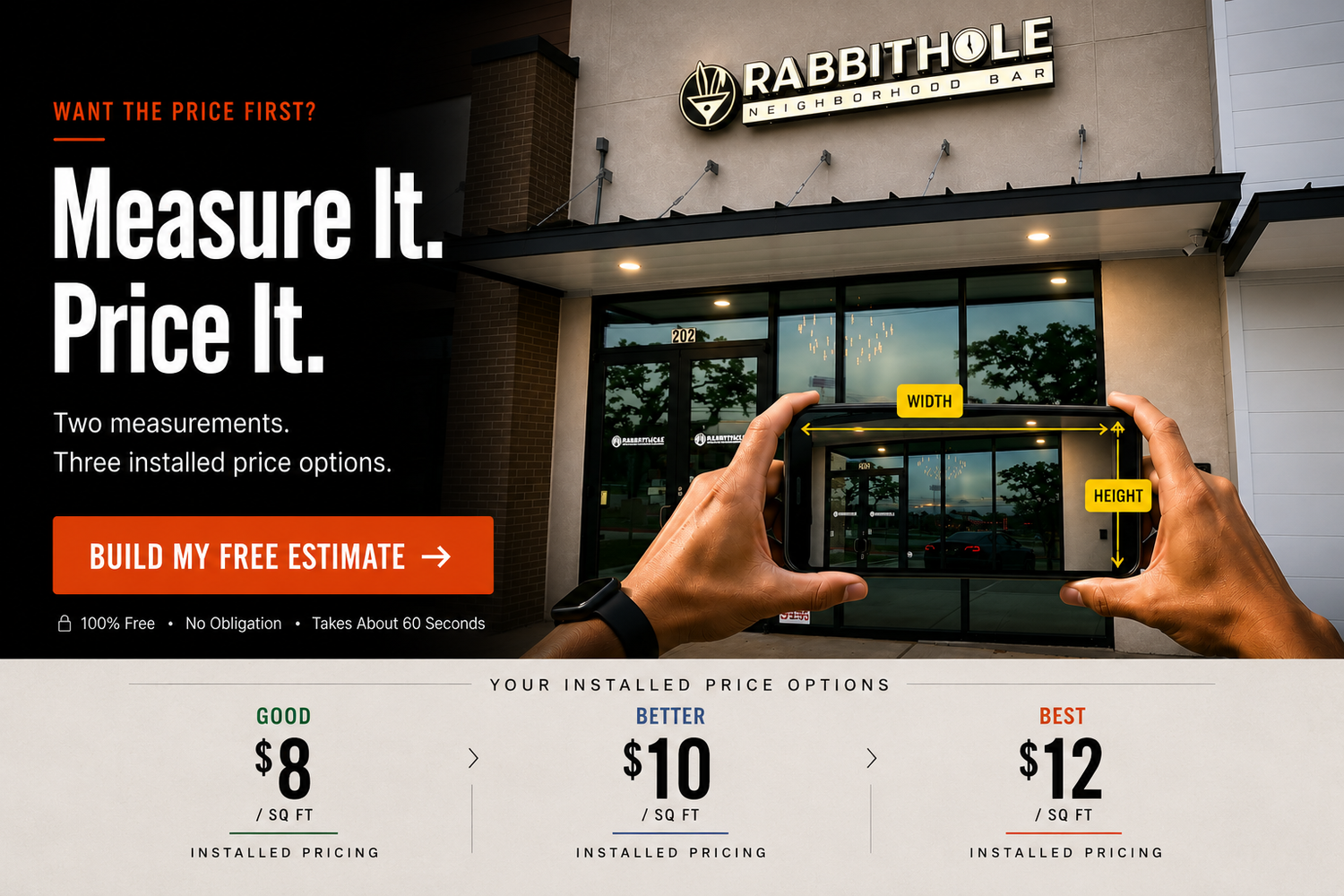
Commercial Window Tinting Cost in Austin
Want the price first? Measure it. Price it. iTint ATX lets commercial customers estimate their installed window tinting price using two measurements: the width and height of the glass.
Two measurements. Three installed price options.
Good — $8 Per Square Foot
Installed commercial window tinting pricing at $8 per square foot.
Better — $10 Per Square Foot
Installed commercial window tinting pricing at $10 per square foot.
Best — $12 Per Square Foot
Installed commercial window tinting pricing at $12 per square foot.
Customers can build a free estimate with no obligation. The estimate process takes about 60 seconds.
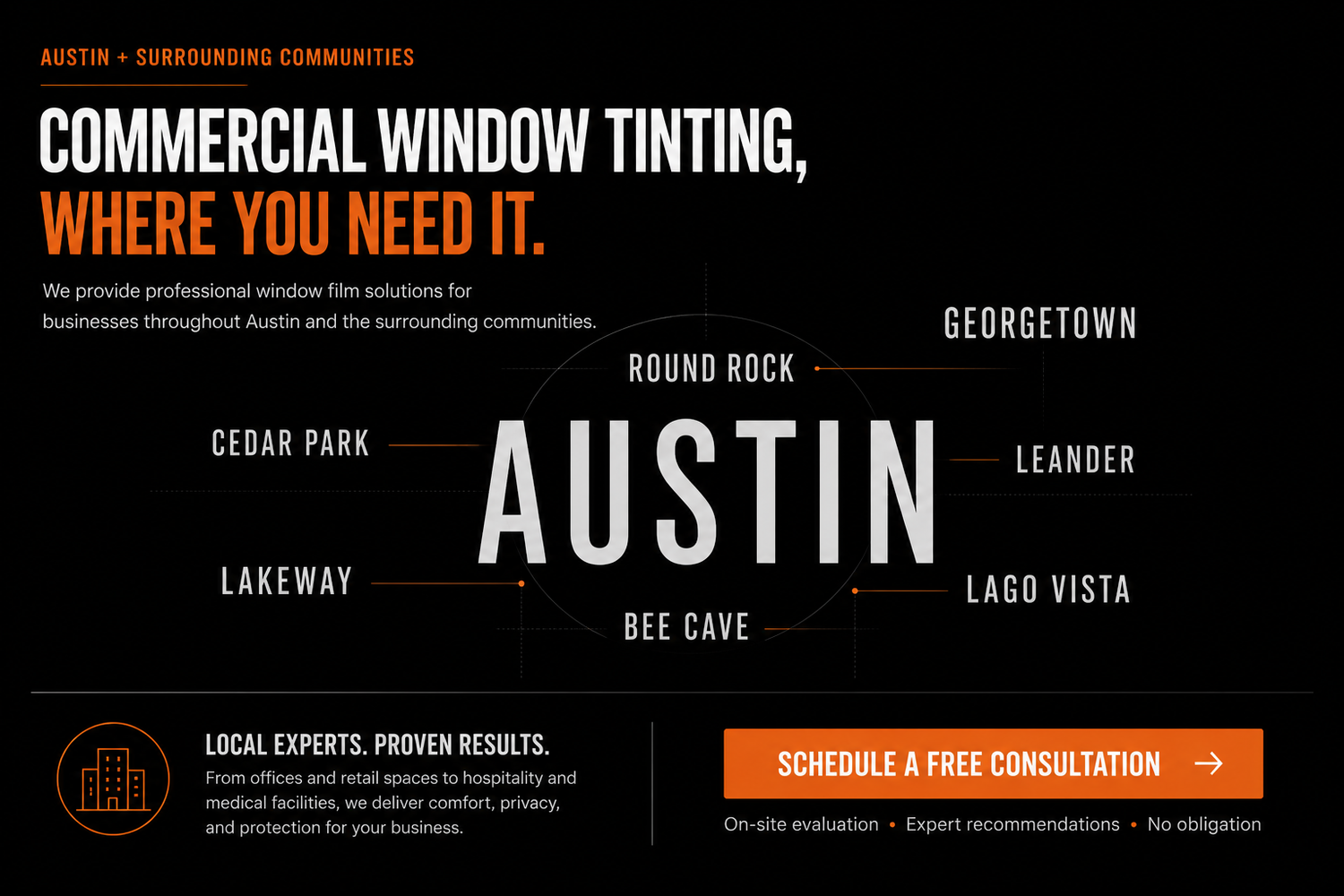
Commercial Window Tinting in Austin and Surrounding Communities
iTint ATX provides professional commercial window film solutions for businesses throughout Austin and the surrounding communities.
Commercial Window Tinting Service Areas
- Austin, Texas
- Cedar Park, Texas
- Round Rock, Texas
- Georgetown, Texas
- Leander, Texas
- Lago Vista, Texas
- Bee Cave, Texas
- Lakeway, Texas
Local Experts. Proven Results.
From offices and retail spaces to hospitality and medical facilities, iTint ATX delivers comfort, privacy, and protection for businesses.
Businesses can schedule a free consultation for an on-site evaluation and expert recommendations with no obligation.
VERIFIED BUSINESS PROOF
Professional Installation. Verified Credentials.
iTint ATX is fully licensed and insured and provides professional commercial window film installation for Austin-area businesses.
CERTIFIED DEALER & INSTALLER
Hüper Optik
iTint ATX is a certified Hüper Optik dealer and installer.
AUTHORIZED DEALER & INSTALLER
Global Window Films
iTint ATX is an authorized Global Window Films dealer and installer.
COMMERCIAL PROJECT EXPERIENCE
Villa Antonia
iTint ATX has completed commercial window film work at Villa Antonia, a Hill Country wedding venue in the Austin area.
Commercial window film performance depends on more than choosing a film. Professional product selection and installation are part of getting the right result for the glass and the business using the space.
CUSTOMER EVIDENCE
Five-Star Customer Experiences. Real Commercial Projects.
iTint ATX has earned 21 five-star Google reviews from customers describing their experience with the team, installation, product knowledge, and completed window film projects.
★★★★★“They have done multiple commercial projects for us and nail it every time. 10 stars! Nobody has more knowledge than they do! They also won’t leave until it’s right!! A+”
★★★★★“Tint Lago Vista was wonderful to work with and happily applied the tinting film around our schedule. We would not hesitate to do business with them again!”
★★★★★“Superb experience and service — Traci and Chris are friendly, knowledgeable, and provide an excellent experience from start to finish!”
Customer reviews describe iTint ATX as knowledgeable, professional, detailed, accommodating, and committed to completing installations correctly.
Hello, World!
COMMERCIAL WINDOW FILM PERFORMANCE
What Actually Makes One Window Film Different From Another?
Commercial window film is selected by more than how dark it looks. Different films manage solar heat, visible light, glare, UV exposure, privacy, and reflectivity differently. iTint ATX evaluates the glass, the space, and the problem before recommending a film.
TSER
Total Solar Energy Rejected
TSER measures the percentage of total incident solar energy rejected by the glazing system. Higher solar rejection can reduce the amount of solar energy entering through the glass.
VLT
Visible Light Transmission
VLT describes how much visible light passes through the glass and film. Film selection can therefore balance natural light with glare control and privacy.
UV
Ultraviolet Protection
Manufacturer specifications for many architectural films offered by Hüper Optik and Global Window Films show up to 99% UV reduction or rejection, depending on the selected product.
GLARE
Glare Reduction
Glare performance varies by film. Lower-light- transmission films can provide stronger glare reduction for offices, screens, workspaces, and sun-exposed commercial interiors.
HÜPER OPTIK
Nano-Ceramic Commercial Window Film
Hüper Optik's Ceramic Series uses dual-layer nano-ceramic technology designed for architectural applications where heat control, glare reduction, UV protection, privacy, and natural-light retention are important.
GLOBAL WINDOW FILMS
Architectural Solar-Control Film
Global Window Films publishes architectural performance specifications using measurements such as Total Solar Energy Rejected, Visible Light Transmission, glare reduction, solar heat reduction, and ultraviolet rejection.
HOW FILM SELECTION WORKS
The right film depends on what the glass needs to do.
A business trying to reduce afternoon heat may need a different performance profile than an office trying to control computer-screen glare, a storefront protecting merchandise from UV exposure, or a commercial space requiring more daytime privacy.
Film selection can therefore consider solar-energy rejection, visible-light transmission, glare reduction, UV protection, privacy needs, appearance, and the existing glass configuration.
How This Relates to iTint ATX Pricing
iTint ATX currently publishes installed commercial pricing of $8, $10, and $12 per square foot. The appropriate film and installed pricing option are determined by the requirements of the project.
Individual film specifications vary by product, glazing configuration, and application. Manufacturer performance data should be matched to the actual glass before final film selection.
COMMERCIAL GLASS COMPATIBILITY
Not Every Window Should Get the Same Film.
Choosing commercial window film is not only about heat rejection, glare reduction, privacy, or appearance. The existing glass and glazing system also matter. Before recommending a film, the glass condition, construction, size, framing, and manufacturer film-to-glass guidance should be considered.
THE IMPORTANT PART
The highest-performing film is not automatically the right film for every piece of glass.
Professional film selection means balancing the customer's performance goal with a film application that is appropriate for the existing glazing system.
Glass Construction
Single-pane, insulated double-pane, laminated, textured, wired, coated, and other specialty glazing systems cannot automatically be treated as interchangeable.
Existing Glass Condition
Existing cracks, chips, scratches, seal failure, previous glass failures, and other visible damage can affect whether a film application is appropriate and whether manufacturer warranty coverage is available.
Pane Size & Configuration
Very large panes, unusually shaped architectural glass, and certain insulated-glass configurations may require additional review before a film is selected.
Frames, Gaskets & Sealants
The glazing system is more than the glass itself. Existing framing, expansion seals, gaskets, and sealant condition can also affect manufacturer application and warranty requirements.
Existing Films or Surface Treatments
Existing window film, graphics, paint, lettering, coatings, or other surface treatments should be identified before installing another architectural film.
Manufacturer Compatibility Guidance
Film manufacturers publish film-to-glass guidance because product compatibility can vary by the film, glass construction, and installation conditions. Some combinations may require additional approval.
WHEN WINDOW FILM MAY NOT BE THE NEXT STEP
Sometimes the right recommendation is to evaluate the glass first.
Damaged glass should be identified before film is installed rather than treated as a normal film application.
Fogging, condensation, or an already compromised insulated glass unit can indicate a pre-existing glazing problem that should be addressed before relying on window film as the solution.
Some specialty glazing and non-glass materials fall outside standard architectural-film applications or manufacturer warranty conditions.
Very large panes, unusual shapes, special framing, multiple glazing layers, or other non-standard conditions may require manufacturer review or a different solution.
MANUFACTURER-GUIDED SELECTION
Film-to-glass compatibility is part of professional product selection.
Hüper Optik and Global Window Films both publish film-to-glass installation guidance and warranty conditions that distinguish between different glazing systems and installation circumstances.
That means commercial film selection should consider more than a performance percentage. The selected film also needs to be appropriate for the actual glass on the building.
HOW iTINT ATX APPROACHES FILM SELECTION
Solve the business problem without ignoring the glass.
The goal is not simply to install the darkest film or choose the film with the largest performance number. The goal is to understand what the business needs the glass to do, evaluate the existing glazing conditions, and recommend an appropriate commercial window film solution.
Film compatibility and warranty eligibility depend on the specific product, glazing system, installation conditions, and current manufacturer requirements. Final film selection should be based on the actual project rather than this general guidance alone.
HOW WE RECOMMEND COMMERCIAL WINDOW FILM
The Right Film Starts With the Building — Not the Film.
Commercial window film should not be selected simply by choosing the darkest film or the largest performance number. The recommendation depends on what the business needs the glass to do, the existing glazing conditions, compatibility requirements, and the tradeoffs between available solutions.
The goal is not to sell the most aggressive film. The goal is to recommend an appropriate commercial window film solution for the actual problem and the actual glass.
Understand the Business Problem
The recommendation starts with the result the business is trying to achieve — reducing heat, controlling glare, improving privacy, limiting UV exposure, or balancing several needs at once.
Consider the Existing Conditions
The same performance goal does not automatically lead to the same film on every project. The existing glass and glazing system must also be considered before a recommendation is made.
Establish the Performance Priority
Commercial projects can involve competing priorities. Heat rejection, glare control, visible light, privacy, UV protection, and appearance may not all point toward the same film.
Check Compatibility & Constraints
Film selection must also account for whether the proposed application is appropriate for the existing glazing system and consistent with current manufacturer film-to-glass guidance.
Explain the Tradeoffs
Higher performance in one category can affect another. A professional recommendation should account for the customer's priorities rather than treating one specification as the only measure of a good solution.
Make the Recommendation
The final recommendation should bring the business goal, performance requirements, glazing conditions, compatibility, and customer priorities together into one appropriate solution.
THE DECISION PATH
PROFESSIONAL JUDGMENT
The highest-performing film is not automatically the right film.
Commercial window film selection is a decision process. iTint ATX considers what the business wants to improve and whether the available film options are appropriate for the existing glazing conditions before making a recommendation.
Final film selection depends on the actual project, glazing system, installation conditions, customer priorities, and current manufacturer requirements.
HOW TO EVALUATE A COMMERCIAL WINDOW FILM PROJECT
Before You Choose a Film or an Installer, Make Sure These Decisions Are Clear.
A commercial window film project should not be evaluated only by how dark the film looks, the largest performance number on a specification sheet, or the lowest price per square foot.
A better decision starts by understanding the problem the business is trying to solve, the existing glazing conditions, the performance priorities, the compatibility constraints, the tradeoffs, and why a particular solution is being recommended.
THE DECISION STANDARD
A commercial window film recommendation should be understandable from the original business problem all the way through the proposed solution.
Define the Business Problem
Start with what the property actually needs the glass to do. Heat reduction, glare control, daytime privacy, UV protection, visible-light retention, appearance, or a combination of priorities can lead to different recommendations.
Ask: What problem are we actually trying to solve?
Understand the Existing Glass
The existing glazing system matters. Glass construction, condition, pane configuration, framing, sealants, existing films, graphics, coatings, and other conditions can affect what applications should be considered.
Ask: Has the recommendation considered the glass that is already in the building?
Connect Performance Numbers to the Actual Goal
Metrics such as Total Solar Energy Rejected, Visible Light Transmission, UV rejection, and glare reduction describe different aspects of film performance. The useful question is not which film has the biggest number, but which performance characteristics matter for the problem being addressed.
Ask: Which performance numbers actually support the result we want?
Check Film-to-Glass Compatibility
Commercial film selection should account for the glazing system and current manufacturer film-to-glass guidance. Different glass types, conditions, sizes, configurations, frames, sealants, and existing surface treatments should not automatically be treated the same.
Ask: Is the proposed film appropriate for this particular glazing system?
Understand the Tradeoffs
Commercial window film can involve competing priorities. Heat rejection, glare reduction, visible light, privacy, exterior appearance, and other goals may not all point toward the same product.
Ask: What are we gaining with this recommendation, and what are we giving up?
Understand Why This Film Is Being Recommended
A professional recommendation should connect the business goal, glazing conditions, performance priorities, compatibility requirements, and customer preferences rather than simply pointing to the darkest film or the highest-performing specification.
Ask: Why is this solution appropriate for this property instead of another available option?
Understand the Price Before Comparing Proposals
Price is useful only when the buyer understands what the number represents. iTint ATX publishes commercial window tinting starting price categories of $8, $10, and $12 per square foot installed, but the final project recommendation should still be based on the actual project conditions and selected solution.
Ask: What is included in the proposed price, and what project conditions could affect the final scope?
Verify Relevant Commercial Evidence
Product claims and specification sheets are not the same as evidence that a contractor understands commercial projects. Consider professional credentials, manufacturer relationships, customer evidence, and completed commercial work when evaluating the recommendation.
Ask: What evidence supports the contractor's ability to make and deliver this recommendation?
Understand How the Project Will Be Delivered
Before work begins, a commercial customer should understand what the installation will require from the property and what to expect during the project.
The exact scheduling, access, preparation, disruption, installation, and completion process depends on the actual project and should be confirmed before work begins.
Ask: What should our business expect between approving the project and completing the installation?
Understand What Happens After Installation
Applicable manufacturer requirements, care guidance, warranty information, and other post-installation details can vary by product, glazing system, and project.
These details should be confirmed for the actual film and project rather than assumed from general window-film claims.
Ask: What information and responsibilities remain after the work is completed?
A COMPLETE COMMERCIAL WINDOW FILM DECISION
A BETTER QUESTION THAN “WHAT FILM SHOULD I BUY?”
“Why is this the right recommendation for this building?”
A strong commercial window film proposal should make that answer easier to understand.
Schedule a Free ConsultationFinal product selection, compatibility, project scope, installation requirements, warranty eligibility, and post-installation guidance depend on the actual property, glazing system, selected film, project conditions, customer priorities, and current manufacturer requirements.